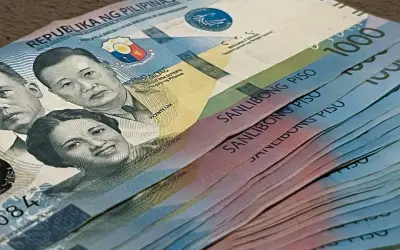
MANILA, Philippines — Money sent home by Filipinos abroad rose to a seven-month high in July, offering a lifeline to households grappling with higher consumer prices and providing a steady source of support for the economy during a difficult period.
Cash remittances coursed through banks rose 1.9 percent from a year earlier to $3.2 billion, the Bangko Sentral ng Pilipinas (BSP) reported on Tuesday. This was the highest monthly inflow since December 2025, when Filipinos abroad wired $3.5 billion to their families back home.
In the first seven months, remittances grew at an annualized rate of 2.3 percent to $20.4 billion.
The central bank estimated such inflows to hit $36.6 billion by the end of the year, which would mark a 2.7-percent increase from the 2025 tally.
The increase came even as the peso continued to weaken, a trend that might encourage overseas Filipinos to send fewer dollars because each one now buys more pesos.
The currency is nearing the 63-per-dollar level as the greenback strengthens broadly.
Remittances, unlike private capital, tend to hold up during economic downturns and natural disasters as Filipinos abroad send more money to help their families weather difficult times.
That support has become particularly important as inflation has climbed above the central bank’s 3-percent target amid disruptions stemming from the war in the Middle East, while intense monsoon rains paralyzed economic activity in affected areas.
“Remittances continue to demonstrate resilience and remain a critical buffer for the Philippine economy,” said Jonathan Ravelas, senior adviser at Reyes Tacandong & Co.
“The latest data suggest steady—not spectacular—growth, with the weaker peso providing additional support but not fundamentally changing the long-term trajectory of remittance inflows,” Ravelas added.
The United States remained the largest source of remittances, followed by Singapore and Saudi Arabia, based on reported transactions by origin. The BSP said the large US share may partly reflect the fact that most remitting or correspondent banks are located there.
“These inflows provided continued support to household consumption and domestic economic activity, underscoring the resilience of remittance flows as an important source of external financing and household income,” the central bank said.